UV Pool Cyanuric Acid Balance: Why Stabilizer Still Matters With UV
| July 5, 2026
A UV pool still needs the right cyanuric acid level. UV light can reduce certain contaminants as water passes through the chamber, but it does not protect chlorine from sunlight in the pool itself. That job belongs to stabilizer, also called CYA.
The balancing act is keeping enough CYA to protect free chlorine outdoors without letting the level climb so high that chlorine becomes slow to respond. If the pool looks dull, burns through chlorine, or needs constant shocking, CYA belongs on the checklist alongside UV flow, filter pressure, pH, and free chlorine.
Affiliate disclosure: As an Amazon Associate, UV Pool Filter may earn from qualifying purchases through links on this page.
Why UV does not replace stabilizer
UV sanitation happens inside the equipment. Sun protection happens in the pool water. Once chlorinated water leaves the UV chamber and returns to the pool, sunlight can still break down unstabilized chlorine quickly, especially in hot weather with long afternoon sun exposure.
A properly balanced outdoor pool usually needs a measured CYA level so chlorine lasts long enough to sanitize steps, benches, ladders, corners, and surface areas between equipment passes. The UV unit supports the sanitation plan, but it does not create a residual sanitizer in the pool.
Calculate doses from fresh test numbers
Pool Chemical Calculator helps turn current free chlorine, pH, alkalinity, stabilizer, and pool volume readings into practical adjustment targets. That matters when CYA changes the free chlorine level you need to maintain.
Download Pool Chemical Calculator for iPhone/iPad
Download Pool Chemical Calculator for Android
Use the pool calculator website
What happens when CYA is too low
Low stabilizer can make a sunny pool lose free chlorine fast. Owners sometimes blame the UV lamp, the filter, or the salt system when the real problem is that sunlight is stripping chlorine before it can maintain a useful residual.
- Fast chlorine loss: Free chlorine tests fine in the morning and crashes by afternoon.
- Recurring haze: The pool looks clear after dosing, then slowly turns dull again.
- More chemical chasing: Frequent shock treatments hide the pattern instead of fixing the protection level.
- Weak residual coverage: UV treats water in the chamber, but exposed pool surfaces still depend on chlorine.
What happens when CYA is too high
Too much stabilizer creates the opposite problem. Chlorine may remain on the test strip or drop test, but it can be less responsive unless the free chlorine target is raised to match the CYA level. This is where many pools drift into cloudy water even though the owner sees chlorine on the test.
If CYA is high, avoid stacking more stabilized chlorine products without a plan. Trichlor tablets and dichlor shock add stabilizer as they add chlorine. In a UV pool, high CYA can still slow cleanup, because UV support does not remove the need for an effective free chlorine residual in the body of water.

How to manage stabilizer in a UV pool
Test CYA with a reliable kit, compare it to the sanitizer method you use, then adjust chlorine targets around the measured stabilizer level. If CYA is low, add stabilizer gradually and circulate well before retesting. If CYA is high, dilution is often the practical correction.
Keep the UV side of the system honest too. Confirm the lamp is within service life, the quartz sleeve is clean, the flow switch is satisfied, and the pump speed is high enough for the chamber. CYA balance and UV maintenance work together, but they solve different problems.
Recommended pool maintenance supplies
As an Amazon Associate, UV Pool Filter earns from qualifying purchases.
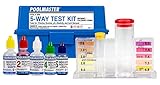
UV helps supplemental sanitation, but chlorine, pH, and alkalinity still need testing.
View on Amazon
A clean cartridge helps protect flow through UV equipment and clears cloudy water faster.
View on Amazon
UV does not replace a measurable sanitizer residual in the pool water.
View on AmazonFAQ
Does a UV pool need cyanuric acid?
Most outdoor UV pools still need some cyanuric acid because sunlight can destroy free chlorine in the pool water. UV treatment inside the chamber does not protect chlorine from sunlight once it returns to the pool.
Can high CYA make a UV pool cloudy?
High CYA can contribute to cloudy water if free chlorine is not maintained high enough for that stabilizer level. The UV unit may still be working, but the pool still needs an effective chlorine residual.
Should I use stabilized chlorine with a UV system?
You can, but track CYA carefully. Trichlor and dichlor add stabilizer over time, so repeated use can push CYA higher than intended and make chlorine management harder.
Does UV lower cyanuric acid?
No. A residential UV pool system does not meaningfully remove cyanuric acid. If CYA is too high, the practical correction is usually water replacement or dilution.