Saltwater Pool Maintenance: The Weekly Checks That Prevent Cloudy Water
| May 20, 2026
Salt pools feel easier than traditional chlorine pools, but they are not maintenance-free. The salt cell is constantly converting dissolved salt into chlorine, and that process only works well when the water is balanced, the cell is clean, and the system is running long enough to keep up with sunlight, swimmers, and debris.
If your pool looks clear today, this is still worth getting right. A salt pool can drift from comfortable and stable to cloudy or algae-prone quickly when pH climbs, stabilizer gets too low, or the salt cell starts scaling. The goal is not to chase perfect numbers every hour. The goal is a simple weekly rhythm that keeps the pool predictable.
Start with the four numbers that matter most
For most backyard saltwater pools, the core weekly check is free chlorine, pH, stabilizer/CYA, and salt level. Total alkalinity and calcium hardness matter too, but those usually move more slowly unless you are adding lots of fill water, draining, or fighting scale.
- Free chlorine: enough sanitizer to match your stabilizer level and bather load.
- pH: often rises in salt pools, so check it regularly.
- CYA/stabilizer: protects chlorine from sunlight, especially in full-sun pools.
- Salt: keep it inside the range recommended by your salt system manufacturer.
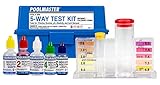
A good test kit is worth the money here. Strips are convenient, but if the pool is already cloudy or you are making chemical corrections, a drop-based kit gives you more confidence.
Calculate chemical adjustments before you pour
Before adding acid, stabilizer, chlorine, or alkalinity increaser, use Pool Chemical Calculator to estimate the dose for your pool size. It helps avoid the expensive cycle of adding too much, then adding something else to undo it.
Download Pool Chemical Calculator for iPhone/iPad
Download Pool Chemical Calculator for Android
Use the pool calculator website
Keep pH from creeping too high
Saltwater pools commonly trend upward in pH. When pH gets high, chlorine becomes less effective, water can feel irritating, and scale can form on tile, heaters, and the salt cell. That scale makes the cell work harder and can shorten its life.
Check pH at least weekly during swimming season. If it is high, lower it carefully with muriatic acid or a dry acid product according to your test result and pool volume. Do not guess from the bottle label alone; pool size changes the dose dramatically.
Do not let stabilizer fall too low
Low CYA is one of the fastest ways to make a salt pool struggle. Without enough stabilizer, sunlight burns off chlorine faster than the salt cell can replace it. The water may test low in chlorine even though the generator is running.
Many salt systems prefer a slightly higher CYA range than manually chlorinated pools, but always check your manufacturer guidance. If you add stabilizer, give it time to dissolve and circulate before retesting. Overshooting CYA is annoying because the practical fix is usually water replacement.
Shop salt pool test kits and maintenance supplies on Amazon before your next round of testing, especially if your current kit is old or hard to read.
Clean the salt cell only when it needs it
A scaled salt cell can reduce chlorine output even if the control panel says everything is fine. Inspect the cell on the schedule recommended by the manufacturer. If you see white crusty buildup on the plates, clean it according to the manual.
Avoid over-cleaning. Acid washing too often can wear down the cell coating. The better long-term move is to keep pH, alkalinity, and calcium hardness in range so scale forms more slowly.

Run the pump long enough for the cell to keep up
Your salt cell only makes chlorine while water is flowing and the system is active. During hot weather, heavy use, or after storms, the pool may need more runtime or a temporary boost mode. If chlorine keeps testing low, do not automatically blame the cell. First check CYA, pH, salt level, pump schedule, and filter pressure.
A simple weekly salt pool routine
- Skim debris and empty baskets.
- Brush walls, steps, and low-circulation corners.
- Test free chlorine, pH, CYA, and salt.
- Adjust pH before it gets far out of range.
- Check filter pressure and clean/backwash only when needed.
- Inspect the salt cell on the manufacturer schedule.
If you want a quick way to estimate chemical doses, bookmark PoolChemicalCalculator.com or use the mobile app while you are standing by the pool.
Recommended pool maintenance supplies
As an Amazon Associate, UV Pool Filter earns from qualifying purchases.
UV helps supplemental sanitation, but chlorine, pH, and alkalinity still need testing.
View on Amazon
A clean cartridge helps protect flow through UV equipment and clears cloudy water faster.
View on Amazon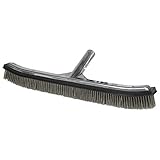
Brushing breaks up algae films and dead spots so sanitation and filtration work better.
View on AmazonFAQ
Why does pH rise so often in a saltwater pool?
Salt systems create aeration and chemical conditions that often push pH upward over time. Regular testing and small acid adjustments are normal maintenance, not a sign that the pool is broken.
Can a salt pool still get algae?
Yes. A salt pool is still a chlorine pool. If chlorine drops too low, CYA is off, circulation is poor, or brushing is neglected, algae can grow.
How often should I clean my salt cell?
Inspect it according to your system manual. Clean it only when you see scale buildup or the manufacturer recommends it. Excessive acid cleaning can shorten cell life.
What should I check first if my salt pool is cloudy?
Start with free chlorine, pH, CYA, filter pressure, and pump runtime. Cloudiness usually comes from weak sanitation, poor filtration, or water balance problems.
Bottom line: Salt pools are easiest when you test weekly, prevent pH drift, protect chlorine with the right stabilizer level, and calculate chemical additions before pouring.
Get Pool Chemical Calculator: iOS | Android.
Disclosure: This post contains Amazon affiliate links. As an Amazon Associate, UV Pool Filter may earn from qualifying purchases.