UV Pool Return Line Eyeball Fitting Cleaning: Restore Directional Flow Before Dead Spots Spread
| August 26, 2026
Disclosure: As an Amazon Associate, UV Pool Filter may earn from qualifying purchases. The pool care links below may also point you toward our Pool Chemical Calculator resources.
Return jets do more than push water back into the pool. The small eyeball fittings inside those returns decide where that clean, treated water goes next. When an eyeball fitting is clogged, scaled, loose, or pointed the wrong way, circulation gets lazy and dead spots can form even while the pump and UV system seem normal.
This catch-up checklist focuses on cleaning return line eyeball fittings so UV-treated water keeps moving across the pool instead of drifting straight back to the equipment side.
Why Eyeball Fittings Matter for UV Pools
A UV chamber only treats the water that reaches it, and the pool still needs strong circulation to move debris, sunscreen film, pollen, and algae spores toward the skimmer and main drain. Return fittings help create that pattern. If one fitting is blocked or aimed poorly, the pool may test fine near a return while corners, steps, benches, or the deep end start to cloud up.
- Weak movement is visible at one return compared with the others.
- Leaves, pollen, or foam collect in the same corner every day.
- The fitting face has calcium scale, sand, hair, or small debris packed around it.
- Water looks dull near steps, benches, ladders, or the deep end wall.
- Filter pressure is normal but surface circulation still feels uneven.
Simple Cleaning Routine
Turn off the pump before removing or adjusting return fittings. Unscrew the eyeball face ring carefully, keeping track of the ball, seat, and any small gasket parts. Rinse away grit and brush scale from the opening with a soft pool-safe brush. Avoid metal tools that can gouge plastic fittings or damage threads.
Before reinstalling, inspect the wall fitting for sand, pebble finish debris, small toys, or broken plastic tabs. Reassemble the fitting snugly without overtightening. Aim returns slightly downward and around the pool in a consistent circular direction, then restart the pump and watch how surface debris moves for several minutes.
Balance Chemistry After Flow Improves
Cleaning return fittings can reveal circulation problems that were masking low sanitizer or drifting pH. Test free chlorine, pH, alkalinity, cyanuric acid, calcium hardness, and salt if you use a salt system. Use the Pool Chemical Calculator, the Pool Chemical Calculator iOS app, or the Pool Chemical Calculator Android app to make measured adjustments.

Weekly Circulation Habit
During swim season, give each return a quick glance while the pump is running. Look for bubbles, weak directional flow, or a fitting that has rotated out of position. Pair that check with skimmer basket cleaning and filter pressure readings so the whole circulation loop supports the UV system instead of fighting it.
Recommended pool maintenance supplies
As an Amazon Associate, UV Pool Filter earns from qualifying purchases.
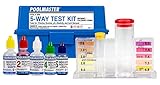
UV helps supplemental sanitation, but chlorine, pH, and alkalinity still need testing.
View on Amazon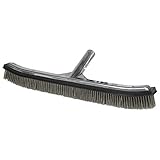
Brushing breaks up algae films and dead spots so sanitation and filtration work better.
View on Amazon
A clean cartridge helps protect flow through UV equipment and clears cloudy water faster.
View on AmazonFAQ
How should return eyeball fittings be aimed in a UV pool?
Aim them slightly downward and in the same general circular direction so treated water moves across the pool, toward low-flow areas, and back to the skimmer and drain.
Can a dirty return fitting cause cloudy water?
Yes. A blocked or misdirected fitting can create dead spots where sanitizer and filtered water do not mix well, especially around steps, benches, corners, and deep-end walls.
How often should pool return fittings be cleaned?
Inspect them weekly during heavy use and clean them whenever flow looks uneven, scale appears around the fitting, or debris keeps collecting in the same part of the pool.