UV Pool Bypass Valve Position Check: Make Sure Water Reaches the Chamber After Service
| October 2, 2026
Disclosure: This article contains affiliate links. As an Amazon Associate, UV Pool Filter may earn from qualifying purchases.
A UV pool bypass valve position check is worth doing after any service visit, filter cleaning, heater work, winterizing adjustment, or plumbing repair. A three-valve bypass can make a UV chamber easy to service, but it can also leave the sanitizer partly or fully bypassed if the handles are not returned to their normal operating positions.
This is not about guessing a perfect valve angle from a photo on the internet. It is about comparing your actual equipment pad to the manual for the installed UV or AOP system, confirming that water is supposed to pass through the chamber during normal circulation, and catching obvious handle-position mistakes before your clear-water routine starts drifting backward.
Compare pool UV bypass valves, unions, and service parts on Amazon. Match replacement valves, unions, and O-rings to the exact pipe size and equipment model before ordering.
Start with the manual and the real pipe path
Look for the brand and model on the UV chamber or controller before moving any valve. Take a clear photo of the full plumbing path from the filter outlet through the heater, UV chamber, salt cell if present, and return line. Then pull up the manual for the exact unit. That gives you a real reference instead of a generic diagram, and it gives your pool professional something useful to check if the layout is crowded.
The CMP DEL AOP plumbing instructions tell installers to place the unit in the main return line after other pool equipment and to observe correct flow directions on components. The Pentair BioShield UV installation guide discusses bypass valves in winterizing and service context, including closing bypass valves so water bypasses the UV body for winter protection. The Hayward HydraPure owner manual also treats installation, operation, and winterizing as equipment-specific work, with power shutoff and service cautions that should not be brushed aside.
The useful takeaway is simple: valve position is part of the manufacturer’s plumbing design. Do not invent flow rates, pressure targets, or handle positions that the manual does not support.
What normal operation should prove
In normal pool operation, the UV system should be included in the return-side water path unless the manual or a qualified pool professional has intentionally placed it in bypass for service, winterizing, troubleshooting, or a known equipment issue. A quick check should answer three questions: where does water enter the UV chamber, where does it leave, and which valve handle would block or divert that path?
If the system has a classic three-valve bypass, the two valves on the UV inlet and outlet are often opened for normal use, while the middle bypass line is adjusted or closed according to the equipment design. That pattern is common, but it is not universal enough to treat as law. Some pads use diverter valves, check valves, actuators, or a side-stream layout where the correct position is less obvious.
- Compare every handle position against the manual or the service company’s startup photo.
- Confirm flow-direction arrows on the chamber, unions, check valves, or labels still make sense after recent work.
- Look for a valve handle left perpendicular to the pipe where the UV inlet or outlet should be open.
- Check whether an automation actuator moved a valve after manual service.
- Write down the normal operating positions before anyone changes them again.
After service, assume nothing
A bypass gets touched for good reasons. A technician may isolate the UV body to remove a lamp, inspect a quartz sleeve, address a leak, winterize the vessel, or troubleshoot a low-flow warning. The problem starts when the system is returned to circulation but the handle positions are not restored, or when one valve is reopened and another is missed.
Walk the pad after service while the pump is off unless the manual says a particular check must be done under operation. Look for a service tag, fresh glue joints, new unions, new O-rings, a changed controller message, or a photo from the technician. If something changed and you are not sure what normal should look like, ask before turning handles. Guessing can send water around the UV chamber, dead-head a section of plumbing, or reopen a vessel that was intentionally isolated. That’s a lot of risk for a handle position that can be confirmed in a two-minute handoff.
Do not override safety and service restrictions
UV pool systems combine water, electricity, pressure, ultraviolet lamps, quartz sleeves, seals, and manufacturer-specific plumbing. A homeowner can photograph valve positions, compare visible arrows, keep notes, and ask a pool professional to confirm the intended operating setup. That is different from opening the chamber, servicing electrical parts, removing lamps, loosening unions under pressure, or modifying glued plumbing.
If the manual says installation, electrical work, lamp service, quartz sleeve service, or internal vessel service belongs to qualified personnel, keep that boundary. Turn off power and relieve pressure only in the way the equipment manual requires. If a valve is stiff, unlabeled, cracked, leaking, or connected to automation, treat it as a service item instead of forcing it.
Pair valve checks with water testing
A UV system is supplemental equipment. It does not replace the sanitizer residual your pool needs, and it cannot fix bad chemistry by itself. If the bypass was wrong for a few days, test the water instead of assuming the UV unit made up the difference. Check free chlorine, pH, alkalinity, stabilizer, calcium hardness, salt if applicable, and water volume assumptions.
The Pool Chemical Calculator can help turn those readings into dosing math. It is also available for iPhone and Android. Keep the chemical log with your bypass photos so the next service visit starts from facts instead of memory.

A simple label-and-photo habit
Once a pool professional confirms the correct normal position, make it easy to recognize later. Save a wide photo of the pad, a close photo of the UV valves, and a note that says when the photos were taken. If labels are appropriate for your setup, use weather-resistant tags that identify normal operation, service bypass, and winterizing notes without covering manufacturer markings.
Safety note: This is pool-care information, not medical advice. Maintain the sanitizer level required for your pool and local rules, follow the UV equipment manual, and use a qualified pool professional for electrical, pressure, lamp, quartz sleeve, internal vessel, automation, or plumbing work when the manufacturer requires it.
Recommended pool maintenance supplies
As an Amazon Associate, UV Pool Filter earns from qualifying purchases.
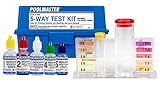
UV helps supplemental sanitation, but chlorine, pH, and alkalinity still need testing.
View on Amazon
A clean cartridge helps protect flow through UV equipment and clears cloudy water faster.
View on Amazon
UV does not replace a measurable sanitizer residual in the pool water.
View on AmazonFAQ
Should the UV bypass valve be open or closed during normal pool operation?
Use the manual and the actual plumbing layout for your installed system. Many bypass manifolds send water through the UV chamber during normal operation and around it only for service or winterizing, but the correct handle positions depend on the equipment and valve arrangement.
Can I turn the bypass valves while the pump is running?
Do not assume that is safe. Follow the equipment manual and your pool professional’s instructions. If a valve may isolate pressurized equipment, affect automation, or change flow through a heater or sanitizer, stop and get qualified help.
Why would a UV system be intentionally bypassed?
Common reasons include winterizing, leak diagnosis, quartz sleeve or lamp service, plumbing repair, or troubleshooting a flow-related warning. The important part is returning the system to the approved operating setup before relying on it again.
Does a correct bypass position mean my water is sanitized?
No. Correct valve position only confirms the UV chamber is included in the water path. You still need proper sanitizer residual, balanced water, filtration, brushing, and testing.