Pool Calcium Hardness: Why Scaling Happens and How to Fix It Before It Damages Your Equipment
| June 5, 2026
If you’ve ever noticed a white crusty ring along your pool’s waterline, gritty deposits on the returns, or rough patches on the plaster floor, calcium hardness is almost certainly behind it. Most pool owners test for chlorine and pH and call it a day — but ignoring calcium hardness is one of the fastest ways to permanently damage plaster, clog filters, and wreck salt cells or UV lamp sleeves.
This guide covers what calcium hardness actually does to your water, the damage it causes at both extremes, how to test it accurately, and the step-by-step fixes to bring it back into range.
What Is Calcium Hardness and Why Does It Matter?
Calcium hardness (CH) measures the total dissolved calcium in your pool water. Along with pH and total alkalinity, it’s one of the three pillars of the Langelier Saturation Index (LSI) — the formula that determines whether your water is corrosive (etching plaster and metal) or scaling (depositing mineral buildup on every surface it touches).
Water is always trying to reach chemical equilibrium. If it’s undersaturated in calcium, it pulls minerals from wherever it can find them: plaster walls, grout, metal fittings, heat exchanger coils. If it’s oversaturated, it deposits that calcium everywhere — on tiles, in return jets, on your salt cell plates, and on UV sanitizer lamp sleeves where scale blocks the UV light from reaching the water.
The target range is 200–400 ppm for concrete and plaster pools, and 150–250 ppm for vinyl or fiberglass.
Signs Your Calcium Hardness Is Too High
High calcium (above 400–500 ppm) produces scale — calcium carbonate deposits that form wherever water evaporates or temperature shifts. You’ll notice:
- White crusty ring at the waterline — especially on tile, which is the first place scale forms
- Cloudy water — when calcium carbonate precipitates out of solution, it turns the water hazy
- Rough plaster floor — scale deposits make the surface feel like sandpaper
- Clogged return jets or reduced flow — scale builds up inside pipes and fittings
- Damaged salt cell or UV lamp sleeve — calcium coats the plates and quartz sleeve, cutting output and forcing premature replacement
Scale is not just cosmetic. Once it bonds to plaster, tile grout, or equipment internals, it’s difficult to remove without acid washing — which itself stresses pool surfaces.
Signs Your Calcium Hardness Is Too Low
Low calcium (below 150–200 ppm) means aggressive, corrosive water. Soft water aggressively dissolves anything it contacts:
- Etched or pitted plaster — dull, rough texture where the surface has eroded
- Corroded metal fittings, ladders, and light rings
- Foamy water — low-mineral water tends to foam more easily
- Irritated eyes and skin — chemically imbalanced water is harder on swimmers
Low calcium is easier to fix than high calcium, but the damage it causes — pitting in plaster, rust staining from corroded metals — can be permanent.
How to Test Calcium Hardness Accurately
Test strips give a rough reading, but for calcium hardness specifically, a liquid drop test kit (titration method) is considerably more accurate. The titration requires adding a buffer solution, a calcium indicator, and then counting drops of EDTA solution until the color changes — each drop equals 10 ppm.
Test for calcium hardness at least once a month during swim season, and immediately after:
- Heavy dilution from rain or splash-out followed by refilling
- Filling from a new water source
- Significant evaporation and top-off
Municipal water calcium hardness varies significantly by region. Some areas have naturally soft water (under 50 ppm) while others have extremely hard fill water above 400 ppm. Knowing your fill water hardness helps you predict problems before they start.
Correcting calcium hardness interacts with your pH and alkalinity — shift one and the others move. The Pool Chemical Calculator walks you through balanced adjustments so you’re not chasing your tail with corrections.
Download the app: poolchemicalcalculator.com/app — available for iOS and Android.
How to Lower High Calcium Hardness
There is no chemical you add to reduce calcium hardness. The only effective options are:
1. Partial Drain and Refill
This is the standard fix. Drain 25–50% of your pool water and refill with fresh water. If your fill water is also moderately hard, you may need multiple partial drains over several weeks to bring levels down without shocking your plaster with a sudden large chemistry change.
Calculate how much to drain using your current calcium level, your target level, and your fill water hardness. The formula:
Volume to drain = Pool volume × (current CH − target CH) / (current CH − fill water CH)
If your fill water hardness is above 300 ppm, partial draining may not help much — you’re trading one hard water source for another. In that case, look into:
2. Reverse Osmosis (RO) Water Recycling
Pool RO services bring a mobile unit to your property, filter your existing water through reverse osmosis membranes, and return it at very low mineral content — without fully draining the pool. More expensive than a drain and refill, but preserves your water chemistry baseline and is worth considering in drought areas or if water costs are high.
3. Sequestering Agents
Sequestering/chelating chemicals (phosphate-based sequestrants, HEDP-based products) bind to calcium and hold it in solution, preventing it from depositing as scale. They don’t remove calcium — the calcium is still there — but they prevent scale formation. Useful as a temporary measure or when you can’t do a partial drain. You’ll need to maintain the sequestrant dose regularly because it depletes over time and gets removed by the filter. Browse pool scale sequestrants on Amazon to find products that fit your system.
How to Raise Low Calcium Hardness
Low calcium is the easier problem to fix. The standard product is calcium chloride (sold as “calcium hardness increaser” or as pool-grade CaCl₂). A few things to know before you dose:
- Calcium chloride dissolves exothermically — it generates significant heat when it hits water. Dissolve it in a bucket of pool water first, then pour around the perimeter while the pump runs. Never pour directly into the skimmer.
- Add incrementally. Don’t try to raise calcium by 100+ ppm in one shot. Large swings stress plaster. Do 25–50 ppm at a time, let it circulate for several hours, then retest.
- Raising calcium also raises total dissolved solids (TDS) and can affect pH slightly. Test after each adjustment.
As a rough rule: 1.25 lbs of calcium chloride per 10,000 gallons raises calcium hardness by approximately 10 ppm. Your calculator will give you the precise dose based on your pool volume and current reading.
Calcium Hardness and UV Pool Systems
UV sanitizers are particularly sensitive to scale. The quartz sleeve surrounding the UV lamp is what separates the lamp from the water — and calcium deposits on that sleeve act like a filter, blocking UV light transmission and dramatically reducing the system’s effectiveness. If you have a UV system and your calcium hardness is running over 350 ppm, cleaning the sleeve every 3–4 months becomes essential rather than optional.
Keeping calcium in the lower half of the target range (200–300 ppm) extends sleeve life, reduces cleaning frequency, and keeps your UV output where it needs to be.
Tile Line Scale: Removal and Prevention
Once calcium has bonded to tile, it won’t brush off. Your options:
- Pumice stone — effective on ceramic and porcelain tile, but never use on vinyl or fiberglass panels
- Calcium and lime removers — diluted muriatic acid or commercial tile scale products; apply, let dwell, scrub, rinse
- Bead blasting / pressure washing — professional service for heavy buildup
Prevention is far easier than removal. If your waterline tile regularly collects scale, keep calcium below 350 ppm and use a sequestrant during the peak summer months when evaporation is highest.

Calcium Hardness Across Seasons
Calcium levels naturally creep up through swim season because evaporation concentrates minerals while the water volume stays the same (you top off with fresh water, but the calcium that evaporated with the old water stays behind — only water molecules leave when water evaporates). In hot climates, calcium hardness can rise 20–30 ppm per month in summer.
Check it monthly, and consider a small partial drain in late summer if levels are approaching 350 ppm. By contrast, when closing for winter, bring calcium up slightly toward 250 ppm before closing — low calcium in cold water is more aggressive and can etch plaster while the pool sits covered.
Disclosure: This post contains Amazon affiliate links. As an Amazon Associate, UV Pool Filter may earn from qualifying purchases.
Recommended pool maintenance supplies
As an Amazon Associate, UV Pool Filter earns from qualifying purchases.
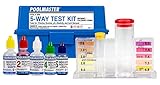
UV helps supplemental sanitation, but chlorine, pH, and alkalinity still need testing.
View on Amazon
A clean cartridge helps protect flow through UV equipment and clears cloudy water faster.
View on Amazon
Brushing breaks up algae films and dead spots so sanitation and filtration work better.
View on AmazonFrequently Asked Questions
What is the ideal calcium hardness for a pool?
For concrete and plaster pools, the recommended range is 200–400 ppm. For vinyl liner and fiberglass pools, a slightly lower range of 150–250 ppm is preferred. Staying in the middle of your range gives you a buffer against seasonal fluctuations without the risk of scale or corrosion.
What happens if calcium hardness is too high?
Water that is oversaturated with calcium deposits scale — calcium carbonate buildup — on pool tiles, plaster, equipment, and return fittings. This causes visible white crusty deposits at the waterline, cloudy water, rough plaster, and can damage salt cell electrodes and UV lamp sleeves by blocking their surfaces. Scale is difficult to remove once it bonds and usually requires acid washing or mechanical scrubbing.
Can I add chemicals to lower calcium hardness?
No chemical additive removes calcium from pool water. The primary fix is a partial drain and refill with fresh water that has lower calcium content. If your tap water is also very hard, a pool RO (reverse osmosis) service is the most effective option. Sequestering agents prevent scale formation but do not reduce the calcium level itself.
How do I raise low calcium hardness safely?
Use calcium chloride, sold as a pool calcium hardness increaser. Pre-dissolve it in a bucket of pool water before adding it to avoid localized heat damage to plaster. Add in increments of 25–50 ppm, circulate for several hours, and retest before adding more. A common dose is roughly 1.25 lbs per 10,000 gallons to raise hardness by approximately 10 ppm.
Does calcium hardness affect UV pool sanitizers?
Yes. Scale from high calcium hardness coats the quartz sleeve of UV sanitizer systems, reducing UV light transmission and cutting the system’s sanitizing effectiveness. If you run a UV system, keeping calcium in the 200–300 ppm range and cleaning the sleeve regularly is important for maintaining full UV output.