Green Pool Recovery: How to Clear Algae Fast and Keep It Gone
| June 2, 2026
A green pool isn’t just an eyesore — it’s a health hazard. Algae-clouded water can hide drowning victims from view, irritate swimmers’ skin and eyes, and create the perfect environment for bacteria to multiply. The good news: even a severely green pool can be cleared in 24 to 72 hours if you follow the right sequence. Skip a step, though, and you’ll end up adding chemicals to soup and wondering why nothing is working.
This guide covers the complete green pool recovery process, from the initial assessment through the final polishing steps. These are real numbers and real techniques — not the vague “add shock and wait” advice you’ll find elsewhere.
Assess the Situation Before Spending Money
Not all green pools require the same treatment. Light-green water with visible bottom usually means a recent chlorine lapse and early algae growth. Dark-green or black-green water where you can’t see the steps typically means an established algae bloom that’s been building for days or weeks.
Before buying anything, test your water chemistry. You need to know:
- Current free chlorine (FC) — probably near zero
- pH — algae raises pH, so expect it above 7.8
- Cyanuric acid (CYA) — this determines how much chlorine you need
- Total alkalinity (TA) — needs to be in range before shocking works
If your CYA is above 100 ppm, partial drain and refill may be necessary before shocking will do anything useful. High CYA locks chlorine in a bound state where it can’t kill algae effectively, no matter how much you add.
Adjust pH Before You Add Shock
This is the step most people skip — and why their shock doesn’t work. Chlorine effectiveness drops dramatically when pH is high. At pH 8.0, only about 3% of chlorine is in the active hypochlorous acid form. At pH 7.2, about 66% is active.
Target pH 7.2–7.4 before shocking. Add muriatic acid or pH Down to bring it into range. If your alkalinity is above 120 ppm, you’ll likely need to lower that first, since it buffers pH upward. Aim for TA in the 80–120 ppm range.
Get exact chemical doses for your pool size — no guesswork.
📱 Download for iOS |
🤖 Download for Android |
🌐 Use the Web Calculator
Calculate the Right Shock Dose
The standard rule for green pool shock: raise free chlorine to 30 ppm for light green, 40 ppm for medium green, and 60+ ppm for dark green or black. These are not typos. Regular “shock” doses of 1 bag per 10,000 gallons (which raises FC by about 5–6 ppm) won’t touch an established algae bloom.
Use calcium hypochlorite (cal-hypo) shock or liquid chlorine (sodium hypochlorite). Cal-hypo is cheaper per pound of active chlorine but raises calcium hardness. Liquid chlorine is safer to add and leaves no residue. For a 20,000-gallon pool with dark green water, you might need 6–10 gallons of 12.5% liquid chlorine to hit 60 ppm — calculate based on your actual volume and CYA level.
Never premix cal-hypo with other chemicals. Add it by broadcasting around the perimeter of the pool with the pump running, not by dumping it all in one spot.
Run Your Filter Continuously During Recovery
Once you’ve shocked, your filter does the heavy lifting. Run it 24/7 until the water clears. Backwash or clean your filter every 6–8 hours during this period — algae loads will clog it fast, especially if you have a sand filter. A clogged filter means dirty water just recirculates instead of getting filtered.
Sand filters often struggle with dead algae because the particles are so fine they pass right through. Add a clarifier or use a flocculant (discussed below) to clump the particles together before the filter can catch them. DE filters handle algae better due to finer filtration; cartridge filters need frequent rinsing.
You can find quality UV pool sanitizers on Amazon (affiliate link) — a UV system dramatically reduces the chemical load needed to keep algae from returning once you’ve cleared this outbreak.
Brush Every Surface — Including the Steps and Stairs
Algae holds on to surfaces, and dead algae that isn’t physically dislodged will keep the water cloudy long after the chlorine has done its job. Brush the walls, floor, steps, and any shaded areas thoroughly at least twice during recovery — once at the start and once after the first major clarification.
Pay special attention to returns, steps, ladder bases, and any textured surfaces like exposed aggregate. Algae loves those rough spots. A stiff-bristled nylon brush for vinyl or plaster, or a steel brush for bare concrete, makes a big difference.

Use a Flocculant for Faster Clearing
If your pool is still cloudy after 24 hours of filtering and brushing, a flocculant can speed recovery significantly. Flocculant causes fine particles to clump into heavy masses that sink to the bottom. You then vacuum them to waste — not through the filter.
To use flocculant: lower the water level slightly (you’ll be vacuuming water to waste), add the flocculant, run the pump for 2 hours to distribute it, then turn off the pump and let the pool sit undisturbed for 8–12 hours. The bottom will be coated with a gray-green sediment layer. Vacuum slowly to waste, disturbing it as little as possible.
This technique can clear a pool in one treatment where continuous filtering would take 3–4 days.
Hold Chlorine and Test Frequently
During recovery, test chlorine every 4–6 hours. You want to maintain FC above 10 ppm until the water is visibly clearing. If chlorine drops to zero, algae can regrow — you’ll be back at square one. Add maintenance doses as needed.
Once the water is visibly clearing (you can see the bottom at 3+ feet), you can start backing off toward normal operating range. For an unstabilized pool, that’s 2–4 ppm FC. For a stabilized pool, target FC based on your CYA level — typically 7–10% of CYA for a safe minimum.
Final Polishing and Prevention
Once the water is clear, balance your chemistry fully: pH 7.4–7.6, TA 80–120 ppm, calcium hardness 200–400 ppm, and CYA at 30–50 ppm for non-salt pools. Run your filter another 24 hours after clearing to capture any remaining fine particles.
To prevent recurrence:
- Test chlorine at least twice a week during summer, more in hot weather or heavy bather load
- Brush weekly even when the water looks perfect
- Keep CYA below 80 ppm — above 100 ppm makes maintaining adequate FC impractical
- Consider a UV system to reduce chlorine demand and create a secondary barrier against algae
Recommended pool maintenance supplies
As an Amazon Associate, UV Pool Filter earns from qualifying purchases.
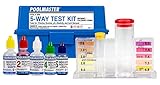
UV helps supplemental sanitation, but chlorine, pH, and alkalinity still need testing.
View on Amazon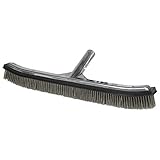
Brushing breaks up algae films and dead spots so sanitation and filtration work better.
View on Amazon
A clean cartridge helps protect flow through UV equipment and clears cloudy water faster.
View on AmazonFrequently Asked Questions
Q: How long does it take to clear a green pool?
A: Light-green pools with early algae typically clear in 24–48 hours with proper shocking, filtering, and brushing. Dark-green or established algae blooms can take 3–5 days of continuous treatment. Using a flocculant can cut clearing time in half for stubborn cases.
Q: Can I swim in my pool while treating it for algae?
A: No. During shock treatment, free chlorine is 10–60 ppm — far too high for safe swimming. Wait until FC drops below 5 ppm (ideally below 3 ppm) before allowing swimmers back in. Test before swimming, not just by time.
Q: My pool turned green overnight — is that normal?
A: Overnight green usually means chlorine hit zero and existing algae spores germinated rapidly. This can happen after heavy rain (dilutes chlorine, raises pH), very hot days (increases chlorine demand), or missing a treatment. It’s fast precisely because algae growth accelerates exponentially once conditions are right.
Q: Why isn’t my shock working?
A: The most common reasons: pH is too high (above 7.8 makes chlorine largely inactive), CYA is too high (above 80–100 ppm binds chlorine), or the shock dose is too low for the severity of the bloom. Test chemistry first, fix pH, then calculate the correct shock dose based on your pool volume and CYA level.
Q: Should I add algaecide to kill algae faster?
A: Algaecide is preventive, not curative. It won’t meaningfully accelerate recovery in an established bloom. Chlorine shock is the primary treatment. Add algaecide after clearing as part of your weekly prevention routine — it provides a useful backup barrier when chlorine dips temporarily.
Disclosure: This post contains Amazon affiliate links. As an Amazon Associate, UV Pool Filter may earn from qualifying purchases.