Salt Pool Low Chlorine: What to Check Before Replacing the Cell
| May 27, 2026
A salt pool can feel almost effortless when everything is working. Then one week the water starts looking tired, free chlorine keeps testing low, and the salt system still says it is running. That is when people start cranking the output to 100 percent and hoping the cell catches up.
Sometimes that works. Often it does not, because low chlorine in a salt pool is not always a bad cell. It can be low salt, short pump runtime, high CYA, scale on the cell, weak flow, warm weather, heavy swimming, or a chemistry issue that makes the chlorine disappear faster than the generator can make it.
Start with the obvious: is the salt system actually producing?
Look at the control panel before changing chemistry. Check whether the system is on, whether it shows a flow warning, whether the output percentage is set too low, and whether the unit is in a cold-water or low-salt shutdown mode.
Salt chlorine generators only make chlorine when several conditions are met: enough flow, enough salt, acceptable water temperature, a working cell, and a schedule that gives the system enough time. If one of those is missing, the pool can test low even though the equipment looks normal at a glance.
Check free chlorine at the right time
Testing at sunset tells a different story than testing at noon. Full sun, swimmers, warm water, and organics can burn through chlorine during the day. If you test only in the late afternoon, you may think the salt cell is failing when the real issue is daily chlorine demand.
Test free chlorine in the morning and again later in the day for a couple of days. If the morning reading is already low, production may be insufficient overnight or the pool may be consuming chlorine constantly. If morning is fine but afternoon crashes, sunlight, CYA, runtime, or bather load may be the main culprit.
Do not ignore stabilizer
Salt pools need enough cyanuric acid, or CYA, to protect chlorine from sunlight. Without enough stabilizer, the cell can work hard all day and still lose the fight to UV exposure from the sun. Too much CYA creates the opposite problem: chlorine is buffered so heavily that normal free chlorine targets may not keep algae away.
If a salt pool is low on chlorine, CYA should be part of the first test set, not an afterthought. Guessing at stabilizer is a great way to create two problems instead of one.
Confirm salt with an independent test
The number on the control box is useful, but it is not perfect. A scaled or aging cell can misread salt. Water temperature can affect readings. Some systems average salt levels over time, so the displayed number may lag behind the water you have today.
Use salt test strips or a drop test to confirm the actual salt level before adding bags of salt. Overshooting salt is annoying because the fix is usually water replacement. Add salt in smaller steps, circulate thoroughly, and retest before adding more.
Calculate salt, chlorine, and stabilizer before adjusting
Salt pool problems get expensive when you guess. Pool Chemical Calculator helps estimate salt, chlorine, shock, stabilizer, pH, alkalinity, calcium, and other pool adjustments from real test results.
Use Pool Chemical Calculator online, download it for iPhone/iPad, or install the Android app.
Inspect the salt cell for scale
Scale on the cell plates reduces chlorine production and can trigger warning lights. Turn off power, follow the manufacturer’s instructions, and inspect the cell visually. White crust, flakes, or heavy buildup between plates means the cell needs attention.
Do not acid clean the cell every time you look at it. Acid cleaning can shorten cell life if overused. Rinse loose debris first, then use the recommended cleaning solution only when scale is actually present.
If you need salt test strips, cell cleaning stands, replacement o-rings, or pool salt, this salt pool maintenance supplies search on Amazon is a practical place to compare options.
Make sure pump runtime matches chlorine demand
A salt cell only produces chlorine while water is flowing and the generator is active. If the pump runs six hours but the pool needs ten hours of production in hot weather, the chlorine level will drift down no matter how good the cell is.
Raising output percentage and increasing runtime are not identical. Output controls how hard the cell works during active production. Runtime controls how long it gets to work. In hot weather or heavy use, you may need both more output and more hours.

Rule out algae before blaming the cell
Early algae can consume chlorine as fast as the salt cell produces it. The pool may not look green yet. It may only look flat, dusty, or slightly cloudy. Check shady walls, steps, ladders, light niches, and corners where circulation is weaker.
If chlorine is repeatedly low, brush the pool and consider an overnight chlorine loss test. If free chlorine drops significantly overnight when there is no sun, something in the water is consuming chlorine. A salt cell is designed to maintain a clean pool, not rescue a developing algae bloom by itself.
Use liquid chlorine for recovery
When a salt pool is already behind, use liquid chlorine or an appropriate shock product to bring the level up quickly. Do not force the salt cell to do the entire cleanup. Running at 100 percent for days can wear the cell while still not catching up fast enough.
Once the water is clear and holding chlorine, let the salt system maintain the level. Maintenance is what salt cells do best.
Where UV sanitation fits
If your pool has both UV and salt, remember that they solve different parts of the sanitation picture. UV treats water inside the chamber as it passes through. The salt cell creates chlorine that leaves a residual in the pool.
UV can support water quality, but it does not replace a measurable chlorine residual. If chlorine is low, check salt production, CYA, pH, flow, and demand. Do not assume the UV system will cover a salt cell that is underproducing.
A salt pool low-chlorine checklist
- Test free chlorine and pH.
- Check salt system power, output, flow, water temperature, and warning lights.
- Verify salt level with an independent test.
- Test CYA so sunlight protection is not guesswork.
- Inspect the cell for visible scale only after turning power off safely.
- Check pump runtime and increase production time if needed.
- Brush the pool and look for early algae in low-flow areas.
- Use liquid chlorine for recovery if the pool is already behind.
The winning move is to treat the salt system like part of a complete pool-care system, not a set-it-and-forget-it machine. When salt, stabilizer, runtime, pH, and flow line up, the cell has a much easier job.
Recommended pool maintenance supplies
As an Amazon Associate, UV Pool Filter earns from qualifying purchases.
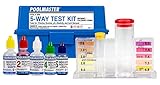
UV helps supplemental sanitation, but chlorine, pH, and alkalinity still need testing.
View on Amazon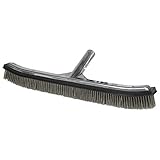
Brushing breaks up algae films and dead spots so sanitation and filtration work better.
View on Amazon
A clean cartridge helps protect flow through UV equipment and clears cloudy water faster.
View on AmazonFAQ
Why is my salt pool showing low chlorine even though the generator is on?
Common causes include low salt, short pump runtime, low output setting, high chlorine demand, low CYA, high CYA, scale on the cell, poor flow, cold water, or early algae consuming chlorine.
Should I turn my salt chlorine generator to 100 percent?
Temporarily, maybe. But if the pool is already low or cloudy, use liquid chlorine to recover faster, then adjust output and runtime for maintenance.
How often should I clean a salt cell?
Inspect it periodically and clean only when scale is present or the manufacturer recommends it. Unnecessary acid cleaning can shorten cell life.
Can low stabilizer make a salt pool lose chlorine?
Yes. Without enough CYA, sunlight can burn through chlorine quickly, making the salt system work harder than it should.
Does UV replace chlorine in a salt pool?
No. UV can support sanitation inside the chamber, but the pool still needs a measurable chlorine residual from the salt system or another chlorine source.
Disclosure: This post contains Amazon affiliate links. As an Amazon Associate, UV Pool Filter may earn from qualifying purchases.